
Article: Organising Your Campsite: Clever Ideas for More Comfort and Storage
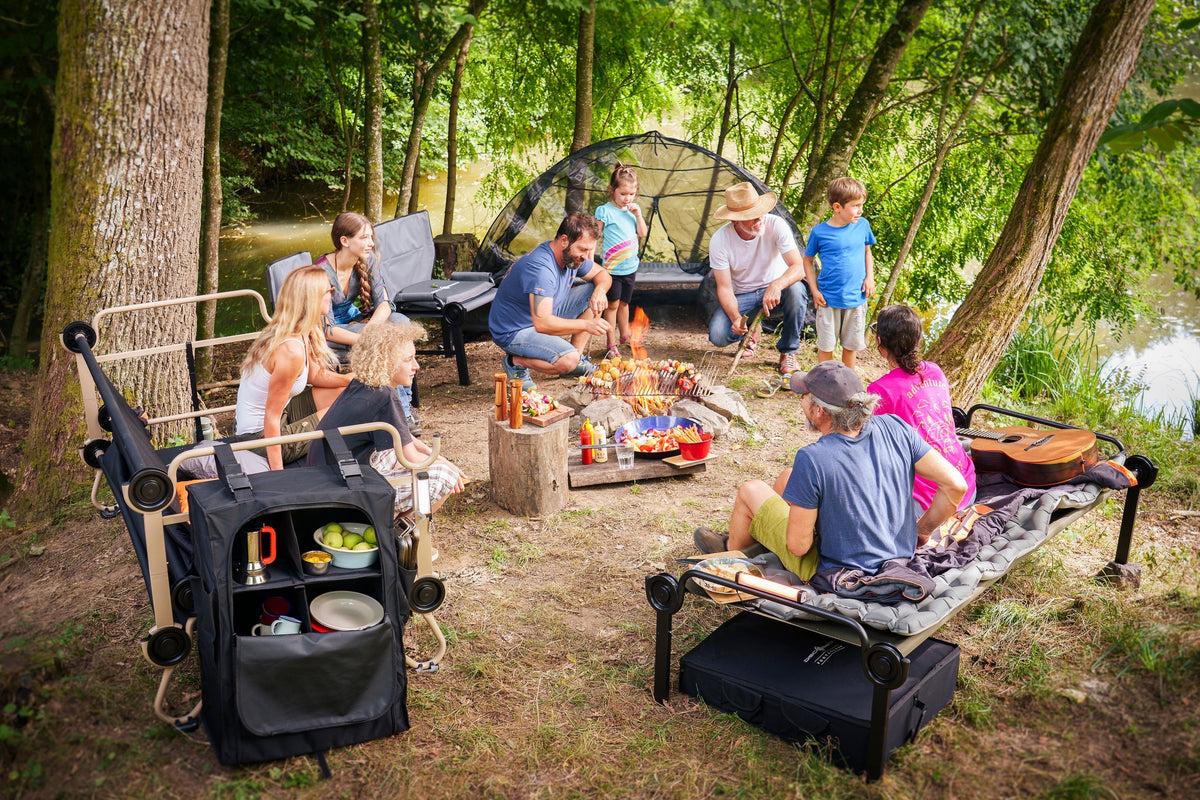
Organising Your Campsite: Clever Ideas for More Comfort and Storage
The camping holiday has only just begun – and shoes are already lying outside the tent entrance, clothes are spread across bags and chairs, while the torch, sunscreen and charging cable have disappeared just when they are needed.
In a limited space, even a manageable amount of camping equipment can quickly create clutter. It not only looks untidy, but also wastes time in everyday life and can create trip hazards.
With thoughtful organisation, consistent routines and clever storage solutions, your pitch stays tidy. We show you how to create more order in your tent, caravan or awning and make the best use of the available space.
Why organisation is especially important when camping
When camping, a large part of daily life takes place in a small space. Sleeping, changing, cooking, eating and relaxing often all happen within just a few square metres.
Unlike at home, however, there are no large wardrobes, storage cupboards or separate rooms. Every item therefore needs a fixed and sensibly chosen place.
Good campsite organisation offers several benefits:
- important items are easy to find,
- walkways and entrances remain clear,
- delicate equipment is better protected,
- the available space is used efficiently,
- setting up and packing away are quicker,
- the pitch feels calmer and more comfortable.
A clear structure makes a significant contribution to a relaxing holiday, especially during longer stays, family camping trips or when travelling with several people.
1. Start organising while you pack
Organisation at the campsite does not begin after you arrive; it starts at home. If you distribute your equipment across different bags and boxes without a system, you will spend a long time searching and rearranging everything at your destination.
Divide your camping luggage into fixed categories, for example:
- sleeping
- clothing
- cooking
- food
- personal care
- leisure
- technology
- tools and repairs
- first aid
Use a separate bag, box or packing cube for each category. Different colours, labels or symbols help you identify the contents at a glance.
Transparent boxes are particularly practical because you can see what is inside. Opaque containers should have clearly legible labels.
Less is often more
Before setting off, think critically about which items you genuinely need. Many things are packed just in case and are never used during the entire holiday.
More luggage means:
- less space in the vehicle,
- more work when unloading,
- more items that need to be organised,
- longer set-up and pack-down times.
A reduced selection of versatile camping equipment creates more space and makes organisation easier.
2. Divide the campsite into zones
A well-organised pitch works much like a small home. Each area has a particular purpose.
Mentally divide your campsite into different zones:
Sleeping area
Keep only sleeping bags, blankets, pillows, nightwear and personal items needed during the night here.
Cooking and dining area
Food, crockery, the camping stove and kitchen utensils should be stored together and at a sufficient distance from the sleeping area.
Living area
Camping chairs, a table and leisure items create a dedicated area for eating, reading and relaxing.
Dirty and wet area
Shoes, wet clothing, towels and sports equipment should stay as close to the tent entrance as possible. This prevents dirt and moisture from being carried through the entire sleeping area.
This clear division automatically creates more order. At the same time, everyone travelling together knows where particular items belong.
3. Use the space under the camping bed for storage
The area beneath your sleeping space is often wasted when camping. If you sleep directly on a sleeping mat or a low air mattress, it is difficult to make practical use of this space.
A raised camping bed such as the DOB ONE, on the other hand, creates additional storage space. You can store items such as the following beneath the sleeping deck:
- travel bags
- shoes
- folded clothes
- drinks
- empty carry bags
- sports equipment
- closed storage boxes
It is important not to push items randomly under the bed. Use flat bags such as the DOB Footlocker, boxes or packing cubes and organise them by category.
Frequently used items should be placed at the front. Equipment that is only needed occasionally can be stored further back.
Disc-O-Bed's raised sleep systems provide clearance from the ground and make the space beneath the bed usable for storage. Many models can also be assembled without tools and, depending on the version, used as a single bed, bunk bed or bench.
4. Save valuable tent space with bunk beds
When several people camp together, individual sleeping spaces quickly take up a large part of the tent. In family or group tents especially, this leaves very little room for luggage and movement.
A bunk bed uses not only the floor area but also the height of the tent. Instead of placing two beds side by side, two sleeping decks are arranged one above the other.
This creates more space for:
- bags and suitcases,
- a clear central aisle,
- a small changing area,
- camping furniture,
- play or living areas.
The Disc-O-Bed L bunk bed can be assembled without tools and transported compactly in the supplied carry bags. The modular construction can be used as a bunk bed, two single beds or a bench, depending on your needs.
For particularly tall people or campers who want more space, the Disc-O-Bed 2XL offers a sleeping area measuring 215 × 100 centimetres. Integrated side organisers provide additional storage for smaller personal items.
5. Create vertical storage
When camping, people often use only the floor space. Tent walls, bed frames and secure suspension points can provide additional room.
Suitable options include:
- hanging organisers
- wardrobes
- side organisers
- nets
- hooks
- small hanging pockets
These can keep clothes, personal care items, books, chargers and personal belongings neatly organised.
An important rule is to place light items at the top and heavy items at the bottom. This keeps hanging organisers stable and prevents unnecessary strain.
Also make sure not to attach anything to delicate tent walls that could damage the fabric or impair ventilation.
Additional storage directly beside the bed
The Disc-O-Bed Cabinet wardrobe attaches directly to a compatible bunk bed without tools. Removable dividers allow you to configure the compartments individually. After camping, the wardrobe can be completely folded down for compact transport.
It can store items such as:
- T-shirts and underwear,
- towels,
- books and magazines,
- personal care items,
- games,
- small electronic devices,
- personal belongings.
This creates a small camping wardrobe without taking up any additional floor space. Extremely practical!
6. Always keep small items in the same place
It is usually not the large bags that cause clutter. More often, it is the small things that disappear:
- car keys
- smartphone
- glasses
- torch
- charging cable
- sunscreen
- insect repellent
- headphones
- power bank
Assign these items a fixed place. This could be a side organiser on the bed, an organiser by the tent entrance or a particular compartment in a wardrobe.
It is especially useful to group things by when they are used. A small bedside pouch could contain glasses, a smartphone and a torch. Sunscreen, insect repellent and a power bank could be kept ready in an outing compartment.
The side organisers on various Disc-O-Bed models allow frequently used items to be stored directly beside the sleeping area. Suitable organisers are included with the Disc-O-Bed 2XL, for example.
7. Use camping chairs as a storage solution too
Camping chairs are often considered only as seating. Models with integrated pockets can also help keep the living area tidy.
The Disc-Chair features rear and side pockets. They can hold items you want close at hand while relaxing, for example:
- water bottle
- book or magazine
- sunglasses
- smartphone
- card or board games
- torch
- charging cable
The Disc-Chair can be assembled without tools and comes with a carry bag. Its removable seat is easy to care for, while the integrated pockets provide additional storage.
Delicate items should still be taken into the tent or vehicle in the evening to protect them from moisture and changing temperatures.
8. Store clothing compactly and clearly
Clothing often takes up a particularly large amount of space when camping. Traditionally folded garments quickly become jumbled inside bags as soon as something from the bottom layer is needed.
It is more practical to roll clothing or divide it between individual packing cubes.
One possible arrangement is:
- underwear and socks
- tops
- trousers
- sleepwear
- sportswear and swimwear
- warm clothing
- dirty laundry
For short trips, clothing can also be prepared by day. This avoids a lengthy search in the morning.
Worn and clean clothing should always be kept separate. A sealable bag or laundry sack prevents odours and moisture from transferring to the rest of your clothes.
Handling wet clothing correctly
Wet towels, swimwear and waterproof jackets should not remain rolled up in closed bags. If possible, hang them outside the sleeping area on a washing line or in a well-ventilated place.
When it rains, use a sheltered area beneath an awning or in the porch. Make sure that air can still circulate.
9. Separate shoes from the living and sleeping areas
Shoes are one of the most common causes of dirt and clutter in a tent. Even after a short walk, they can bring in sand, soil, grass or moisture.
Create a fixed shoe zone directly by the entrance. Depending on the weather, you can use:
- a shallow plastic box,
- a durable shoe mat,
- a washable bag,
- a small shoe organiser,
- the storage space beneath a raised bed.
Position shoes so that they do not block the entrance or walkways.
A small brush and cloth by the entrance help remove coarse dirt before anyone enters the tent.
10. Store food safely and neatly
A clear system is also important for food. Open packaging attracts insects, may leak or can contaminate other food.
Divide your supplies into categories such as:
- breakfast
- drinks
- snacks
- cooking ingredients
- chilled food
- seasonings
- pet food
Dry food should be kept in sealable containers. Products that require refrigeration belong in a suitable cool box or camping refrigerator.
Food should not be stored directly on the ground and, where possible, not in the sleeping area. This is especially important in regions where animals may be attracted by smells.
Store heavy drinks crates and supplies so that they cannot tip over or obstruct walkways.
11. Organise cables and electronic devices
Smartphones, lights, cameras, navigation devices and power banks are now part of everyday camping for many people. However, this can quickly create an untidy tangle of cables and chargers.
Keep electronic equipment together in a padded and preferably water-resistant bag. Use hook-and-loop straps or small cable ties to keep cables together.
For greater safety:
- do not run loose cables across walkways,
- protect extension sockets from moisture,
- do not store electronic devices in direct sunlight,
- do not allow power banks or batteries to overheat,
- only connect to the campsite power supply using suitable outdoor equipment.
Also establish a fixed charging point. This prevents smartphones, power banks and headphones from ending up in different places around the tent.
12. Maintain order with an evening routine
Even the best organisation system only works if it is used regularly. A short evening routine prevents clutter from building up over several days.
Take a few minutes before going to sleep to:
- put away crockery and food,
- place shoes in their designated spot,
- hang up wet clothing,
- sort worn clothes into the laundry bag,
- keep the torch and keys within easy reach,
- protect delicate items from rain,
- keep entrances and exits clear.
If several people are travelling together, each person should be responsible for a particular area. Children can also take on smaller tasks, such as putting their own shoes, toys or clothes in the designated place.
Organisation when setting up and packing away
A well-designed system not only saves time during the holiday, but also makes packing away easier.
Follow a consistent sequence:
- Pack away personal belongings and electronic devices.
- Pack clothing and sleeping equipment.
- Secure kitchen utensils and food.
- Clean and pack away camping furniture.
- Allow the tent or awning to dry completely.
- Count small parts and pegs.
- Check the pitch for rubbish and forgotten items.
Where possible, pack equipment straight back into the same categories you used for the outward journey. Everything will then already be sensibly organised for the next camping trip.
Label carry bags and check before travelling home that all components are complete and dry.
Practical checklist for a tidier camping trip
Before travelling
- Sort equipment into categories
- Label bags and boxes
- Create a packing list
- Remove unnecessary items
- Replace damaged bags and containers
- Check that all camping equipment is complete
At the campsite
- Define sleeping, cooking and living areas
- Keep entrances and walkways clear
- Use storage space beneath the beds
- Store small items in side organisers
- Separate wet and dry clothing
- Store food in closed containers
- Leave shoes by the entrance
Before leaving
- Clean and dry equipment
- Collect all small components
- Separate clean and worn clothing
- Check food supplies
- Relabel bags where necessary
- Leave the pitch clean
Conclusion: more organisation means more relaxation
Keeping a campsite tidy is not a question of large cupboards or numerous storage boxes. What matters is a thoughtful system, fixed places and camping equipment that combines several functions.
Sort your luggage at home, divide the pitch into different areas and use the available space as efficiently as possible. Raised sleeping spaces create storage under the bed, while bunk beds save valuable floor space. Side organisers, hanging storage and folding wardrobes ensure that even small items remain easy to find.
With Disc-O-Bed's flexible sleeping and storage solutions, a cluttered tent becomes a comfortable and functional retreat. You spend less time searching and tidying – and have more time for the camping adventure itself.
Discover Disc-O-Bed's flexible sleep systems and practical organisers and make the most of the available space on your next camping trip.